

Japan is home to a thriving startup ecosystem including a rapidly growing number of business owners, investors, and support organizations. It has an extensive history of technological innovation, and this tradition is reflected in the variety of startups in Japan that are flourishing today.
Robotics, healthcare, fintech, e-commerce, and gaming are some of the most prominent sectors of startups in Japan. A lot of Japanese entrepreneurs are devoted to developing cutting-edge technology solutions that can assist in resolving some of society’s most urgent problems, including aging populations, labor shortages, and environmental concerns.
For business founders and sales teams who are thinking of entering the Japanese market, we recommend you check out our article on market entry and our podcast series on how to enter the Japanese market.
- What is a startup
- Differences in startups in Japan and the US
- How to make a startup in Japan
- Kabushiki Gaisha (K.K.) vs Godo Kaisha (G.K.)
- Challenges of making a startup in Japan
- Benefits of launching a startup in Japan
- What are some successful cases of startups in Japan
- How has the landscape changed for startups in Japan in the last 10 years
- Where to find jobs in startup companies in Japan
- Upcoming startups in Japan in 2023
- Best foreign startups in Japan
What is a startup
A startup is a newly formed business that is in the process of commercializing and bringing a new product, service, or technology to the market. Startups are frequently distinguished by their original concepts, the rapid potential for growth, and entrepreneurial zeal. However, many entrepreneurs are confused by the term startup and mistakenly think it applies to any new business just starting and we will clarify this further below.
Startups frequently encounter difficult challenges in their early stages, such as seeking funding, building a team, and building traction. They have the potential to upend old markets, launch new businesses, and provide investors with substantial financial returns, among other significant benefits.
Startups are frequently founded by business owners who want to market a novel product or service that they believe will address an unmet need or solve a particular problem. These businessmen frequently put in a lot of effort to develop and polish their ideas, seeking advice along the way from possible clients, investors, and consultants.
Although not all new businesses may be categorized as startups, the word is often applied to organizations that are pursuing novel business ideas that do not currently exist nor are proven to have exponential development potential. Typically +$100 million of US annual revenue in market size – the word startup would not typically apply to a business like a restaurant, gym, or an online store which has a proven business model and is NOT a novel concept – however, it could apply to a novel online marketplace like Airbnb and Etsy. As a result, startups are now widely regarded as one of the key drivers behind innovation and economic growth.
Despite their differences in size, structure, and purpose, startups and established firms have many things in common. The following are significant parallels between traditional firms and startups:
- Goal-oriented. Startups and established firms alike are goal-oriented and work to add value for their stakeholders. Businesses of all kinds share the desire to accomplish their goals, whether they are concentrated on making money, providing high-quality goods or services, or having a great impact on their community.
- Need for funding: To launch and expand their operations, startups and other business enterprises need financial support. While traditional firms may look for loans or grants from banks, government organizations, or other sources, startups frequently rely on venture capital, angel investors, or crowdfunding to get money to fund their exponential growth to double or triple in size annually and grow past +$100 million in annual revenue.
- Customer-centric: Both startups and normal firms place a strong emphasis on addressing their client’s requirements. Businesses of all stripes can better design goods and services that satisfy consumer wants and provide value by understanding the preferences and needs of their target market.
- Operational challenges. Operational problems include finding workers, handling finances, and creating marketing and sales plans for traditional firms and startups. Even though the scope and complexity of these difficulties may vary depending on the size and stage of the business, all organizations must find effective solutions to these problems.
- Need for innovation. Innovation is necessary for organizations of all sizes to remain competitive in their respective marketplaces. While startups may be more concerned with market expansion and disruptive innovation, traditional firms must still constantly enhance their goods and services to remain competitive.
In Japan, some cities desire to be known for being the place for a certain industry such as Kobe in the health tech industry, Fukuoka in the fintech industry, Aichi in AI, Shibuya in the fintech and e-commerce industries, and Sapporo mainly in the AgriTech industry Check this link to an episode about doing a startup in Japan, particularly in Fukuoka.
Startups in Japan can be incorporated either in the country or outside and investors such as venture capitalists, angel investors, etc., don’t focus on this. This is mainly applied to companies incorporated in the US state of Delaware. Delaware is a desirable location for businesses, especially larger organizations, thanks to its advantageous business laws, the specialized court system, privacy protections, and corporate-friendly culture. While larger organizations frequently see significant benefits in terms of legal protections, tax savings, and efficiency, smaller enterprises may not profit as much from incorporation in Delaware. Delaware’s article about incorporation in Delaware, USA.
Differences in startups in Japan and the US
Startups in Japan and the US differ significantly in a number of key ways.
Although the startups in Japan and the US both have robust ecosystems, the funding environment in each country is very different. While the US has a thriving venture capital sector that makes significant investments in startups, traditional Japanese banks and corporations are more likely to contribute funds. As a result, there are now fewer high-risk, high-reward firms in Japan, and the country’s entrepreneurial culture is becoming more conservative.
We have a great episode with Larry Greenberg about banking and loans in Japan. Another relevant episode about funding is the one with Makoto Shibata about corporate venture capital in Japan.
The US places more of a premium on independence and a willingness to take chances, which can result in more inventive and disruptive firms. With the Japanese culture, it is harder to get sales because networking plays a relevant role in the business. As a foreigner creating a startup in Japan, you probably don’t have a large network of Japanese people who know, like, and trust you, so the importance of personal relationships makes it crucial for foreigners to get started up.
Regulation. Japan has a reputation for having a tight regulatory environment, particularly when it comes to labor regulations, product ingredients or materials, and business formation. This can make it more difficult for businesses to launch and expand fast, especially if they operate in a highly regulated sector. For example, Japan has an approved substance list where all food products can only use substances on the list where the US has more of a “banned substance list” where you cannot use banned materials from health products to food, to how information is managed.
Please check out the link to our seminar with a labor expert discussing this topic. You can also check the episode with Timothy Connors where he talks about product market fit in Japan. Regulations on ingredients in Japan are also discussed in the episode.
Market size. Compared to Japan, the US has a significantly bigger market, which may make it simpler for businesses to launch and expand quickly. Compared to the US, Japan’s domestic market is likewise more uniform, which might make it more difficult for entrepreneurs to pinpoint and target particular market segments. Since there is a smaller market size, there is a chance that the VC or CVC that you are interested in already has an investment in a competitor or similar business.
Language. You will need to localize your startup in Japan. There are foreigners who run companies, but the number is still small so you need sales pamphlets, software in Japanese. If they are not, people question your seriousness for Japan.
Additionally, a lot of businesses decide to go public rather than raising middle stage funding rounds and list their shares on the Japanese stock exchange. With a huge market value, the Japanese stock market is actually the third largest in the world, after only the US and China. Companies in Japan choose to go public for a variety of reasons. They can raise money and gain access to a larger pool of investors, which is one of the key benefits. Increasing a company’s visibility and reputation through becoming public can be beneficial for luring in clients, partners, and staff. Please check out this article that goes into more detail about this.
Japanese businesses are also renowned for their emphasis on Research & Development and innovation, and many of them have created Corporate Venture Capital (CVC) units to keep one step ahead of the competition. Corporations can access fresh sources of innovation and acquire a competitive edge in their respective industries by investing in startups in Japan and developing technology.
Moreover, CVCs can engage strategically with startups in Japan, utilizing their knowledge and technology to improve their current business processes. This may result in additional revenue sources, a bigger market share, and greater effectiveness.
Corporations investing in their expansion and improvement is very common in Japan. Many Japanese firms have created CVC arms as a result of this mentality to promote innovation and maintain competitiveness in their particular industries. This is the reason why there are many CVCs in Japan.
Ikuo Hiraishi, managing director of Infarm – Indoor Urban Farming Japan Inc. discusses startup investment in Japan in 2022 on his Substack. He mentions that despite the global disturbance, the industries of startups in Japan, as well as the venture capital industry, continued to grow. See one graph below:
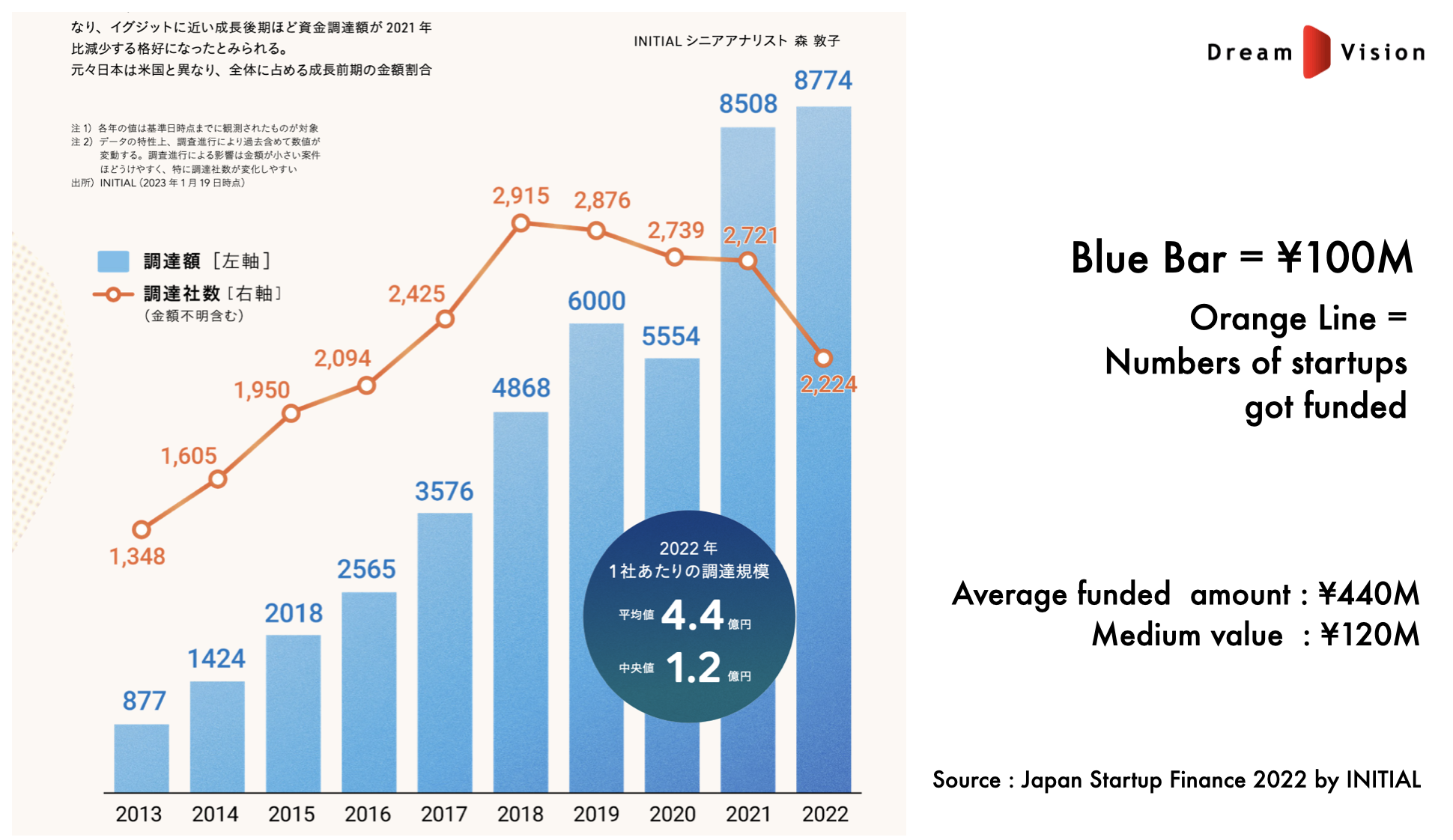
You can check more information in his article linked above.
While there are undoubtedly some similarities between startups in Japan and in the US, there are also a number of important variations in terms of funding, culture, regulation, industry emphasis, and market size. Entrepreneurs who are thinking about launching a firm in either country must be aware of these variances.
How to make a startup in Japan
Although it needs considerable planning and thought, just like any other business venture, starting a startup in Japan can be rewarding. To get started, follow these steps:
- Choose your idea: Begin by choosing a distinct company concept that has the potential to address a problem or close a market gap. Market size, rivalry, and the viability of your idea should all be taken into account.
- Do thorough market research, including competitor analysis, industry trends, and customer research, to validate your business idea. You will gain a better understanding of the potential for your firm and the market demand.
- Make a business plan: Write a thorough business plan that contains the vision, goal, market potential, marketing plan, projected financials, and other important information for your startup.
- Business registration: Register your company with the Japanese government and acquire any relevant licenses. This can include filing taxes, getting a business license, and registering your company name.
- Securing money requires finding possible sources, such as venture capital firms, angel investors, or grants from the government. To get money, create a pitch deck and a strong company strategy.
- Create a team: Assemble a group of qualified experts to aid in the development of your firm, including engineers, marketers, designers, and other crucial positions.
- Create an organizational culture: Create an effective organizational culture that represents the values and goals of your startup. This can promote a sense of community inside your firm and assist in attracting and retaining top employees.
- Launch and iterate: After launching your business, start iterating depending on feedback from customers and market demand. Continually hone and enhance your product or service depending on input from clients and business authorities.
On top of the above list, getting a visa is also required to be able to establish your startup in Japan. There are a number of conditions you must satisfy to establish a legal presence and run a startup in Japan if you represent Visa and are thinking about launching a startup there. To work and launch a startup in Japan if you are a non-Japanese national, you must have the proper visa status. You need to apply for either an investor visa or a business manager visa, depending on your circumstances. Because visa restrictions can change, it is advised that you speak with a knowledgeable immigration attorney. Another way would be to become a permanent resident in Japan although this can be a long and complex process. Lastly, if you are married to a Japanese national, you may be eligible for a permanent residency which will allow you to start your startup in Japan.
Startup cities in Japan such as Tokyo and Osaka can offer help to foreign entrepreneurs looking to launch their businesses there by offering advice and resources on the visa application process. Many of these cities, for instance, have foreign startup support centers that provide advice on visa prerequisites and applications as well as other elements of launching a startup in Japan. You can also check the links below to other cities who provide assistance on visa processing and application:
EJable has also written a great article about how to obtain a startup visa for Japan.
Kabushiki Gaisha (K.K.) vs Godo Kaisha (G.K.)
Startups in Japan also have this unique business structure wherein the business owners can choose to incorporate either a Kabushiki Gaisha (K.K.) or a Godo Kaisha (G.K.). Many startups in Japan choose to incorporate as a KK to have the ability to issue and trade stocks.
A K.K. is required to issue stocks to its shareholders because it is a joint-stock corporation. A way for the business to raise money and for investors to get a return on their investment is therefore made possible by the fact that investors can purchase and sell stocks in the company. Furthermore, a K.K. is subject to tougher guidelines and procedures, which can give investors more confidence and transparency.
Alternatively, a G.K. is not required to issue stock because it is a limited liability business. As a result, stock in the company cannot be bought or sold by investors, and the business may have to turn to alternative sources of funding like loans or equity investments. Although a G.K. is subject to fewer rules and procedures, which might give the organization more flexibility and independence.
Overall, meticulous planning, investigation, and execution are necessary when beginning a startup in Japan. In this thriving and dynamic market, you may build a successful company with the correct strategy, resources, and team.
Challenges of making a startup in Japan
Starting a business or a startup in Japan can come with its own set of challenges. Some of the main challenges include:
- Language Barrier: Japanese is the main business language in Japan, so it might be difficult for non-Japanese speakers to get across the linguistic and cultural hurdles.
- Bank Processes: For one, as mentioned above, Japanese is the main business language in Japan so banks require applicants to fill out application forms and submit supporting documents in Japanese. Additionally, Japanese banks frequently demand that applicants have a registered address in Japan, which can be challenging for non-residents and foreigners who have just arrived in Japan.
Thirdly, a valid visa that allows for a prolonged stay in Japan is typically required for non-Japanese citizens who want to open a bank account there. Depending on the bank and the kind of account being opened, the specific visa requirements could change.
For instance, although some banks might accept short-term visas like tourist or visa waivers, others might demand long-term visas like work or student visas. Banks may also require other paperwork, such as evidence of address, identification, and employment status, in addition to the visa.
Beau Becker, an entrepreneur and the founder of REIWA PHARMACEUTICALS, created a great article about the guide to corporate banking in Japan.
The fourth reason is that more stringent anti-money laundering rules have recently been put in place in Japan, requiring banks to confirm the clients’ identities and sources of payments. Because they might not have a long history in Japan, non-residents and foreigners may find it more challenging to open a bank account.
Lastly, non-residents and foreigners who need these services may find it challenging because Japanese banks may not offer broad international banking service
- High startup costs: Renting office space, purchasing office supplies, paying staff, and paying taxes are all expensive in Japan. Because of this, it may be difficult for companies, especially those with low funding, to get started.
- Regulatory Environment: Japan has a complicated regulatory landscape, and to operate lawfully, companies must abide by a number of rules and obtain the necessary licenses. This can be costly and time-consuming.
- Finding your first client in Japan can be extremely difficult because Japanese businesses prefer to work with partners or vendors who have a proven track record of success and pose little risk. This is because the corporate ladder in a Japanese company is supposedly climbed by the person who makes the fewest mistakes, if any at all. As a startup in Japan seeking clients, many Japanese businesses, not just those in Japan, will approach or reject you.
There are even fewer early adopters in Japan than there are in other countries. If you are a startup in Japan, it is ideal to establish a track record with Japanese companies in your own country or with well-known international corporations that Japanese businesses respect. Ideally, you won’t be gaining your first customers in Japan. Yet, for the reasons listed above, it will be extremely difficult to begin a startup in Japan without any clientele or what they call crossing the chasm in a business venture.
There is a great article created by Akshay Warikoo about crossing the chasm and why certain startups don’t make it to the mainstream market and it covers a comprehensive discussion about the topic.
- It is so difficult to buy or sell products/services in Japan. Because networking is so crucial in Japan, it can be difficult to hire a Japanese salesperson who has a vast network that they can utilize to swiftly generate sales in Japan for the startup.
Experience in selling mature products for corporations
The second reason it’s challenging to find a salesperson is that many people have experience selling mature products for corporations, but when it’s a startup, the business is not selling them the product; they’re selling a single product that’s just been developed, and in some cases, they might not even be aware of who the target market is. As a result, they need a salesperson who is adept at navigating a startup in Japan.
Not enough solid sales people
The third reason it’s challenging is that there aren’t as many salespeople with extensive experience in helping startups available in Japan as there are in other countries, as the ecosystem of startups in Japan is still developing and less developed than that of the US. As a result, Japanese startups are competing for a very small pool of candidates who have the necessary expertise in startup sales.
Most people, especially those who pick up the phone first, do not know how to hire a good salesperson. Tyson Batino, CEO of Scaling Your Company has assisted businesses in creating ideal salesperson profiles and learning where to look for these individuals and helped many companies as a 500 Global Resident Mentor for Japan 2023 Aichi program.
To learn more about how he can help you guide your team to business growth, you can check the services at https://test1.scalingyourcompany.com/coaching/
Benefits of launching a startup in Japan
While the country’s economy is continuously growing, driving a startup in Japan has a number of advantages, including:
Highly Skilled Workforce: The workforce in Japan is very educated and skilled, especially in technology and engineering. This implies that startups in Japan have easy access to qualified individuals who can assist them in establishing and expanding their businesses.
Government Supporting Programs: The Japanese government has put in place a number of programs to assist entrepreneurs, including tax breaks, funding assistance, and incubator programs. Through these initiatives, the financial burden on entrepreneurs is lessened, and they are given the tools and support they need to be successful.
Access to a Big Market: Japan has a big, wealthy corporate consumer base that can give businesses a ready customer base to test and grow their goods or services. Additionally, there is a robust system of channel sales partners who have a giant network of companies they are selling third party software solutions to and if you can make a partnership with them, they can immediately help you scale your startup in Japan. Did you know that zoom gets only 10% of its sales from channel partners in the US, while it gets 70% in Japan? That is how important channel partners are in Japan.
Technological Advancements: Japan is renowned for its technological innovations, particularly in the fields of robotics and automation. Startups in Japan can take use of these developments to create cutting-edge goods and services that will give them a competitive advantage in the market.
Robust Legal Framework for Intellectual Property Protection: Japan has a strong legal framework for intellectual property protection, which is crucial for entrepreneurs creating novel and ground-breaking goods or services.
What are some successful cases of startups in Japan
There have been many successful startups in Japan over the years while its economy is growing and many more are growing as it matures. One example of a startup that succeeds is Gengo, a platform that provides both corporations and individuals with a web-based translation tool. Customers can request expert translations for many sorts of content from websites, papers, and social media posts using Gengo’s platform. The business supports over 70 languages and provides a range of translation services, including both machine and human translation. Developers can include translation services in their own applications using the translation API that is part of the Gengo platform. The reason they are successful is that they made it possible for businesses to obtain translations for a variety of languages at a fair price. Previously, getting translations was very expensive, but they made it affordable. They also give aspiring translators who are just getting started a chance. Although there is a lot of work involved, they also hire translators from other countries outside Japan. The company was founded in 2008 by Robert Laing and Matthew Romaine who is now a venture capitalist at Shizen Capital.
Another success story is Paidy which was sold to PayPal in September 2021 for approximately US$2.7 billion. Paidy offers rapid credit and payment options for both online and offline transactions. With the post-payment option offered by Paidy, customers can make purchases without a credit card or prior registration. Instead, they will be billed each month for their purchases. Paidy also offers interest-free installments and other payment options for customers. The company was started in 2010 by Russell Cummer and Lee Smith. Cummer, an American entrepreneur, formerly worked as a consultant at McKinsey & Company before going to Japan to launch Paidy. Smith, a British entrepreneur, previously worked in finance before co-founding Paidy with Cummer. Since then, Paidy has grown to be one of the most prosperous startups in Japan, having secured over $500 million in funding and forming alliances with significant businesses like JCB and SoftBank. One of the biggest purchases of a Japanese firm in recent years occurred in 2021 when PayPal paid $2.7 billion to acquire Paidy.
The third best example would be Moneytree. Moneytree is fintech startup in Japan that provides a financial management app for individuals and small businesses. Users of the app can link and access all of their financial accounts, including bank accounts, credit cards, and investment accounts, in one location. Also, users may keep tabs on their expenditures, create budgets, and obtain specialized financial guidance.
In addition to the app, Moneytree provides small and medium-sized businesses (SMEs) with a business solution that includes accounting, invoicing, and payroll services. The company’s mission is to assist SMEs in managing their finances more effectively while minimizing the time and resources required.
Moneytree, with its headquarters in Tokyo, was established in 2012 by a group of Japanese businessmen, among them is CEO Paul Chapman. Major Japanese financial institutions including Mitsubishi UFJ Financial Group and Sumitomo Mitsui Financial Group, as well as international businesses like Xero and TransferWise, have partnered with the startup, which has secured more than $100 million in funding. More about their funding is in this article.
The above mentioned companies are but a few instances of successful startups in Japan; there are many more inventive and breakthrough businesses in a wide range of markets, including fintech, healthcare, and gaming.
How has the landscape changed for startups in Japan in the last 10 years
The startup landscape in Japan has seen tremendous change over the past ten years, with a number of trends and advancements occurring. Over the past ten years, the Japanese startup environment has undergone some significant developments. For one, Japan has more startup cities than any other country, which is a significant distinction not till about ten years ago. Nonetheless, there are now numerous cities and prefectures, including Kobe, Osaka, Hamamatsu, Fukuoka, Sapporo, and Aichi competing to establish a base in their locations to create tech jobs, and they are providing numerous subsidies on rent, employing staff, and company formation. For more information on government subsidies, you can listen to Miho Tanaka, a Startup Visa Lead at Startupwork podcast below:
The podcast from the Scaling Japan Podcast with Akiko Nakagawa from the Fukuoka City Global Startup Center, which discusses the city’s support for Startups in Japan is another good episode to listen to if you are interested in opening your startup in Fukuoka City.
The second significant change is how much simpler it is to obtain a visa now than it once was. The costly company manager visa was once required, however, these days a startup visa has been developed which was pioneered by Fukuoka city and eventually followed and embraced by other cities.
In recent years, there’s also been a rise in international investment. Many venture capital firms and accelerators from the US and other nations are moving into Japan, indicating a growing interest from overseas investors in startups in Japan. Consequently, there is also a rise in the corporate venture capital industry. More and more large corporations in Japan have established venture capital sectors or investment funds to invest in startups and promote and support innovation. Jetro created an insightful article that discusses how Japan is opening its doors to foreign investors and talents.
You can also listen to Makoto Shibata, head of FINOLAB, as he shares his insights on the corporate venture capital in Japan and how it can be used to help accelerate the business growth of startups in Japan.
Several huge organizations in Japan are willing to invest a significant amount of money to invest in startups and bring them new technology rather than having to develop it internally. They are also seeking for businesses to acquire in addition to investing in order to reap the financial benefits of their investments.
Another noticeable change in Japan’s business landscape is the apparent increase in tech workers. The pool is added by skilled professionals from around the world as Japan opens more. With many major firms investing extensively in R&D, Japan has a strong culture of innovation and a focus on it. This has contributed to the development of an innovative and entrepreneurial culture in Japan, which has fueled the expansion of the startup ecosystem there.
In the past, many organizations would require strong Japanese abilities but nowadays you can find companies where you don’t need Japanese or you need merely conversational skills to work there.
Lastly, support for female entrepreneurs has been tremendous and significant. To encourage more female entrepreneurs to participate in the startup ecosystem, the Japanese government has established initiatives.
In recent years, Japan has made efforts to encourage and support female entrepreneurs. The government has started a number of programs to aid female entrepreneurs, such as the Women Entrepreneurship Hub, which offers assistance and resources to women business owners at different phases of development. A further objective of the government is to double the number of female entrepreneurs in Japan by 2025. You can check this article for more information about this initiative.
Ultimately, Japan has made tremendous progress in recent years in promoting and supporting women entrepreneurs, even if there is still work to be done to close the gender gap in entrepreneurship in the country.
With greater government support, international investment, and the rise of new startup hubs and industries, the ecosystem of startups in Japan has, overall, undergone substantial changes over the past ten years. These modifications have contributed to the development of a more active and dynamic startup ecosystem in Japan.
Where to find jobs in startup companies in Japan
As Japan’s startup ecosystem rapidly diversifies with more and more business including foreign startups, more jobs are available for those who are interested in starting their career in the industries where startups are big. There are several websites that list startup jobs in Japan. Here are a few:
- Tokyodev: https://www.tokyodev.com/
- Japandev: https://japan-dev.com/
- EJable: https://www.ejable.com/
- Creative Tokyo: https://creativetokyo.com/
- Wantedly: https://www.wantedly.com/
- Justa: https://justa.io/en/
- Indeed Japan: https://jp.indeed.com/
- Startup Jobs Asia: https://startupjobs.asia/
- Jobs In Japan: https://jobsinjapan.com/
- AngelList: https://angel.co/japan/jobs
- Tech in Asia: https://www.techinasia.com/jobs
These websites provide job listings for positions in a range of industries including technology, finance, marketing, and more. Jobs can be found by company, job type, and area.
Upcoming startups in Japan in 2023
The growing startup industry in Japan only means more startup companies being launched by entrepreneurs. In 2023, these are just a few startup companies that have been reported to launch in Japan:
- Skyscape. Aerial image and data analysis services are provided by DroNext, a drone service provider based in Tokyo. The business uses drones to take high-definition photos and videos that can be utilized for a variety of tasks, including mapping, surveying, and inspections. A variety of industries, including construction, real estate, and agriculture, employ DroNext’s services.
- Zookeep. Zookeep runs a website that allows job searchers and potential employers to communicate. The website matches job seekers with opportunities that best match their talents, experience, and career aspirations using machine learning and artificial intelligence (AI) algorithms. The goal of Zookeep is to streamline and improve the job search process for both job seekers and companies.
- Scurid. Scurid offers a cloud-based service for organizing and managing business cards. The platform offers capabilities for organizing and exchanging business cards with others, as well as enabling users to scan, digitize, and save their cards in the cloud.
- Scene. Scene enables users to effortlessly create and share 3D presentations, films, and animations without the need for any specialized technical knowledge. Businesses, instructors, and students that wish to produce interesting and interactive visual material are the platform’s main target audience. A group of seasoned engineers and designers with a love for developing unique and user-friendly solutions launched Giraffe Inc. in 2018.
Best foreign startups in Japan
Japan is home to many foreign startups and several international startups have succeeded in becoming present in the country. Here are a few illustrations:
- Paidy. The company was co-founded in 2014 by Russell Cummer and Lee Smith. Paidy is a Japanese fintech company that provides instant post-pay credit services.
- Moneytree. The company was founded in 2012 by co-founders Paul Chapman, Mark Makdad, and Ross Sharrott. The company provides financial management and analysis services through its mobile app, which allows users to track their spending, manage their budgets, and view their financial accounts in one place.
- Zaiko. It was founded in 2014 by Andrew Winter, Joshua Barry, Lauren Rose Kocher, Malek Nasser with the aim of creating a platform that would help event organizers sell tickets and manage events more efficiently.
- Zehitomo. Japanese online platform that connects users with professionals who provide home repair and renovation services. It was founded in 2015 by James McCarty, Jordan Fisher.
- Gengo. Gengo is a professional translation company that offers translation services in multiple languages, using a network of freelance translators. The company was founded in 2008 by Matthew Romaine and Robert Laing.
The above are just a few of the successful startup companies in Japan in the past 10 years. Seeing the growth of Japan’s startup ecosystem in the past years and the fact that the Japanese government is starting to open its doors to more foreign startup companies, there’s no denying that Japan’s startup industry will continue to rapidly grow in the coming years.F


